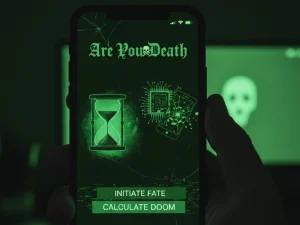




Once again, China and its “Chinisms”. This time it is a «dead» app, viral on Chinese app stores, with a name as unsettling as the Grim Reaper itself, and which to date has been downloaded 10 million times.
It is called “Are You Dead?” — exactly as it sounds. The app was created exclusively for older adults and young people who live alone, without company.
From Monday to Sunday, users must check in by pressing a green button. If you are distracted or “have your head in the clouds” and forget to confirm that you are “still alive” for two consecutive days, the app automatically notifies your emergency contact. And if you do not have a trusted contact, it goes straight to 911.
To join the Are You Dead? community, all you need is your name and the email address of your trusted contact, who will be alerted if you fail to show up within 48 hours.
Now imagine being the emergency contact for a friend who lives alone and receiving one of these emails. You would probably die of panic — assuming you even read it.
That said, there are genuinely macabre stories of people who lived alone and were later found dead or gravely ill. Remember the case in Valencia, Spain, of the man who had died 15 years earlier and was only discovered after neighbours reported a water leak, foul smells and filth? There sat the skeleton of Don Antonio, 86 years old, when police arrived. One cannot help but wonder: had he had this app, might someone have come to his aid?
How do you know you are dying if you are not yet dead? And if you are already dead, how exactly are you meant to press the button? Or does it fall into the same absurd logic as someone supposedly “committing suicide with two gunshots”?
Sileme, Demumu — or Are You Dead, Still?
Also known as Sileme or Demumu, the app was launched by three young developers in Zhengzhou in June 2025. Initially free, it later cost 1 yuan (around 15 US cents) to download. Since going viral in 2026, the price has risen to 8 yuan — roughly one dollar — and its creators are now multimillionaires.
There is no denying that it is a simple, easy-to-use safety tool for people who live alone. It ensures that an emergency contact is alerted if you remain inactive for two days.
What is curious is that it has no push notifications, despite being an app whose entire purpose is to confirm whether you are alive. All it does is send an email — which raises the obvious question: why not a WhatsApp message or an immediate phone call, given that hardly anyone uses email anymore, especially for personal matters? The email warns someone of a possible emergency — though, of course, you might simply have gone out partying and forgotten to press the green button.
And what if you slip in the kitchen and crash hard onto the floor? The bad news is that the app will not alert anyone until two days later. In that case, wouldn’t it be better simply to carry your phone in your pocket and activate an emergency number?
A more realistic solution would be to combine the button with something like a smart ring — such as an Oura ring — or a device that measures your pulse; a watch or bracelet, like the Whoop my mother used, which includes an emergency button. When she began to feel unwell, she pressed it and an ambulance arrived.
But if you fall and knock yourself out cold, it is unclear how this app would help at all. What would really be needed is a system like General Motors’ OnStar.
Here is how it works: the system detects a crash or impact, sensors are triggered — the proverbial red phone rings — and an operator immediately calls to check whether you respond. If you do not, an ambulance, the police, or both are dispatched immediately. Conversely, if you feel unwell or are in trouble, you press the red button and assistance is sent in exactly the same way. That is how such a system should function.
Which brings us back to the name. Is it not the morbid, sensationalist title — which, in my view, captures attention by dramatically posing the question of whether you are alive or dead — that has truly captivated those 10 million users who currently have Are You Dead? installed on their phones? It is worth noting that most of those 10 million are young people, not older adults who might actually need it. Let’s be realistic: many octogenarians or centenarians would not even know how to download an app from the App Store.
The creators argue that the name is better translated as “Are You Dead Still?”, which more closely reflects the Chinese meaning. In Chinese youth slang, it is akin to a casual greeting — something like asking, “Have you eaten yet?” They wanted to play with that idea: “Are you dead still, mate?” Pure marketing. Pure cheap sensationalism — or, in Chinese, “廉价的耸人听闻”.
Now let’s talk about the young people who downloaded it. Many have moved to major cities, far from their hometowns, parents and friends, and now scrape by in vast metropolitan jungles of 30-plus million inhabitants, such as Shanghai — the most populous — or Beijing, with around 22 million residents. And if we are talking about megacities, Jakarta surpasses them all with 41.9 million people, making it the most populated city in the world. One wonders whether Are You Dead? would take off in the Indonesian capital.
I am convinced that this sense of disconnection — from family, home, food and often even one’s country (China has a large population of foreign students) — has made many young people suddenly confront the reality of loneliness, and worse still, the fear of dying alone and unnoticed. If there is a technology that promises to accompany them through this existential agony — very much in the spirit of Nietzsche — they will undoubtedly turn to it.
Seen this way, it is hard to judge these young migrants who live day to day and endure the economic crisis as best they can. Many will never marry or have children, unlike their parents and grandparents. Are they, then, condemned to live — and die — alone?
The figures seem to support this concern. In 2024, the Baker Institute Research Center compiled data on people living alone in China and found that their number had reached 123 million, of whom 110 million are young people and adults between the ages of 20 and 50. Combined with the rise of virtual relationships, this erodes physical contact, traditional support systems and the networks that satisfy the human need for connection with family and friends.
Good or bad, morbid or necessary, Are You Dead? is a trend that may — or may not — prepare us for the challenges of an increasingly isolated society, one in which relationships fade like the wick of a candle. Perhaps the day will come when apps are our new friends and neighbours, and the green button saves us from loneliness.
So — are you ready to download Are You Dead?