

By: Eddy Warman
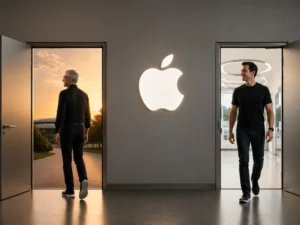
Fifteen years ago, Apple released a statement that seemed to signal the beginning of the end of Steve Jobs’ golden era: the Silicon Valley genius was handing over control to Tim Cook—a low-profile, methodical executive with an obsessive focus on logistics.
Yet, here in 2026, history has delivered a very different verdict from what the world once expected: Tim not only preserved Apple, he rebuilt it as a sovereign entity. However, as his departure on September 1 approaches, he now faces the challenge of proving that Apple can still be magical in a world dominated by artificial intelligence.
The heir to a glass box
When Tim took over in 2011, he inherited a company that was both a cultural phenomenon and financially vulnerable to its own success. It was inevitable: Steve Jobs was Apple’s soul and visionary, while Cook was seen as the quiet master of the supply chain.
Skepticism was widespread: could an operations-driven executive sustain the pace of innovation? At the time, Apple was valued at around $350 billion, and its stock traded at a modest $13 (adjusted for splits).
Faced with this reality, Tim Cook quickly realized that for Apple to survive its founder’s death, it needed to evolve beyond a company that released new hardware every year and become an omnipresent ecosystem embedded in users’ lives.
Financial transformation: the $4 trillion empire
Above all, Tim Cook’s leadership has been a masterclass in value creation. His boldest move was not in devices, but in services—transforming hardware users into recurring subscribers.
Who among us isn’t subscribed to Apple Music, iCloud, Apple Pay, or Apple TV+? These platforms evolved from complementary offerings into revenue engines that, on their own, would surpass most Fortune 100 companies.
Under Cook’s leadership, Apple reached milestones that once seemed like science fiction, becoming the first company to hit $1, $2, $3, and ultimately stabilize at $4.01 trillion in market value.
Today, Apple’s stock trades at $273.05, representing an astonishing growth of over 1,600%, effectively silencing its fiercest critics on Wall Street.
The silicon revolution: total independence
Few realize that perhaps Tim Cook’s most profound technical contribution was Apple’s break from Intel in 2020. By designing its own processors (Apple Silicon—M and A series), the company achieved near-perfect vertical integration.
Thanks to this decision, Apple now operates with 3-nanometer technology in its M5 and A19 chips, controlling every aspect—from energy efficiency to graphical power. This technological sovereignty allows it to run complex AI models locally, something competitors are still struggling to balance.
The user paradox: from iPod to golden cage
Apple’s story is also the story of its users—and their contradictions.
Many of us remember the iPod with nostalgia—not just because it revolutionized the market, but because it was the “Trojan horse” that won us over, marking the beginning of massive brand loyalty.
That business model has remained constant, but the happiness many users project comes at a cost: ecosystem rigidity. For professionals seeking flexibility and compatibility, the experience has often been different.
After years in the Mac environment, many users have migrated to Windows due to connectivity issues and Apple’s difficulty in interacting with open protocols.
In many ways, Apple has become a “walled garden”: beautiful, seamless, and secure on the inside, yet often frustrating for those who need adaptability.
The shadows: cracks in a perfect machine
Even a $4 trillion machine has its flaws.
Cook faced ongoing criticism for prioritizing margins over disruptive innovation. Some notable missteps include:
- Apple Maps (2012): a flawed launch with serious navigation errors
- AirPower: canceled due to overheating issues
- Battery-gate: deliberate slowing of older iPhones, leading to fines and reputational damage
- Bendgate: hardware design flaws, including bending iPhones and defective keyboards
The Siri dilemma and the AI challenge
Siri is a perfect example of how an early advantage can turn into a liability.
Launched in 2011, it stagnated for years due to Apple’s strong focus on privacy, which limited the use of large-scale data. Meanwhile, Google and Amazon surged ahead, leaving Siri behind.
Today, Apple is attempting a comeback with Apple Intelligence. In a pragmatic move, Cook acknowledged they couldn’t do it alone and integrated third-party models such as ChatGPT-4o.
The challenge is immense: to regain leadership in a race where AI is no longer an add-on, but the core engine of modern devices.
The successor: John Ternus
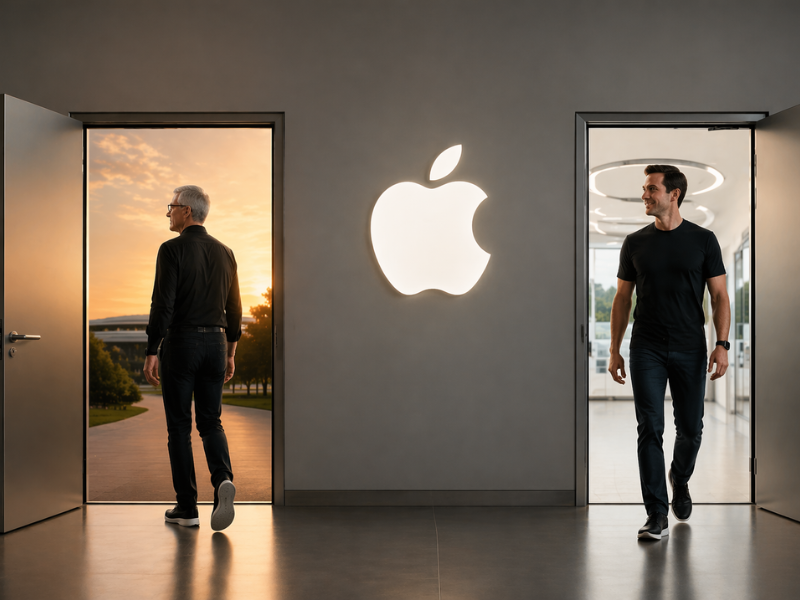
Starting September 1, leadership will pass to John Ternus, Apple’s current Senior Vice President of Hardware Engineering.
Internally, he is seen as the natural successor. Unlike Cook, his profile is deeply technical: a mechanical engineer with over 25 years at the company.
His credibility rests on three pillars:
- Product fixer: corrected past design flaws
- Technical respect: deep engineering expertise
- Continuity with a personal vision: combining stability with a more creative outlook
Tim Cook retires at 65, leaving behind a financially solid Apple. He inherited an innovative company and delivers a global institution worth twelve times more.
Now begins the era of engineer Ternus—one in which Apple aims to ensure that the intelligence of its devices once again becomes, as it was with that first iPod, a truly magical revolution for the world.
The empire has been built. What remains to be seen is whether, under Ternus, Apple can once again think different.