 For more than a century, the tequila business was dominated by companies that controlled farmland, agave plantations, distilleries, inventories, and aging facilities. Legendary brands such as Don Julio, José Cuervo, Herradura, and Sauza built their value on agricultural assets and production infrastructure.
Then, in 2017, Casamigos arrived, and completely rewrote the rules.
It proved that a company with no agave fields, no distillery, and no vertically integrated production could achieve a valuation comparable to businesses that had spent decades investing in land, equipment, and manufacturing capacity.
But that’s only the beginning of the story.
How did George Clooney manage to sell a tequila brand without owning agave fields or a distillery?
This is the story of a deal that permanently transformed the tequila industry.
The Conditions George Clooney Accepted to Sell Casamigos
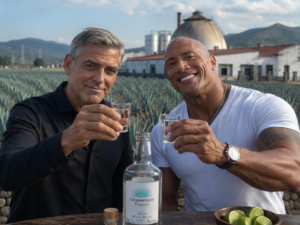
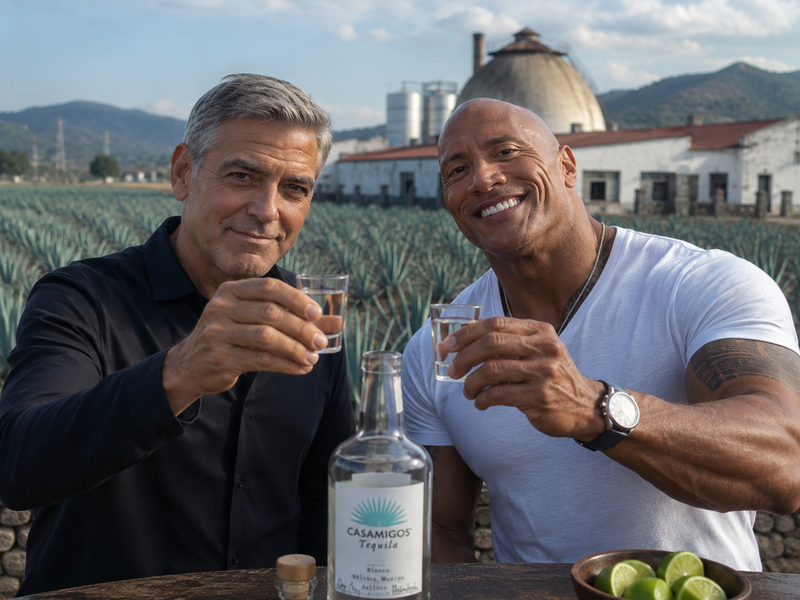
In June 2017, British beverage giant Diageo, the owner of Johnnie Walker, Guinness, Tanqueray, Smirnoff, Don Julio, and dozens of other global brands, announced one of the most surprising acquisitions in the spirits industry: Casamigos, the tequila brand founded by George Clooney, entrepreneur Rande Gerber (husband of supermodel Cindy Crawford and founder of Gerber Group), and real estate developer Mike Meldman.
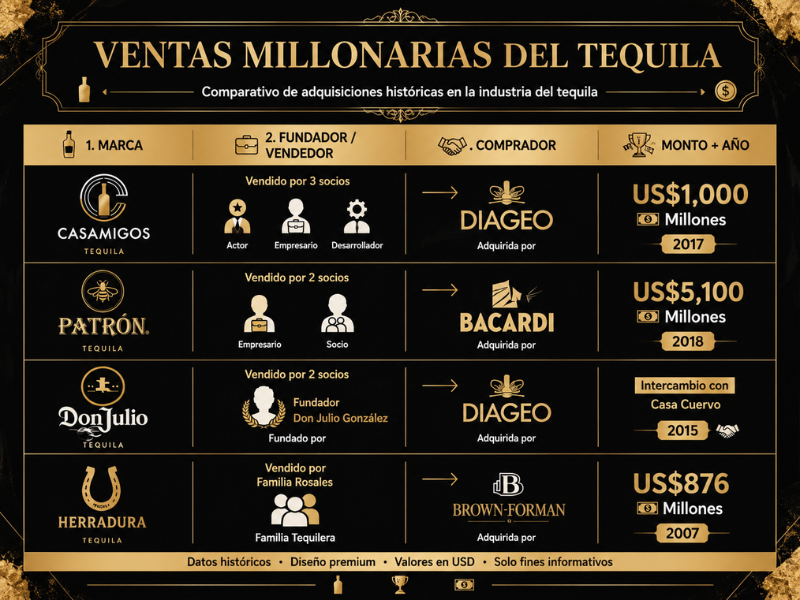
Originally launched in 2013 as a tequila intended exclusively for personal enjoyment among friends, Casamigos was sold just four years later for an upfront payment of $700 million, with additional performance-based payments that could raise the total purchase price to an astonishing $1 billion.
According to Diageo’s official announcement—the acquisition agreement itself has never been made public, Clooney committed to remaining actively involved with Casamigos in order to continue developing the brand. Following the acquisition, both Gerber and Meldman also stayed on as ambassadors and promoters of the label.
The transaction also included an earn-out worth up to $300 million. Of the potential $1 billion purchase price, $700 million was paid at closing, while the remaining $300 million depended on Casamigos’ commercial performance over the following ten years.
This structure aligned the founders’ financial incentives with the brand’s long-term growth.
Although Diageo never disclosed any specific marketing or endorsement clauses, Clooney publicly stated after the sale:
«We’re not going anywhere. We’ll still be a very big part of Casamigos.»
«The Rock» Has His Own Tequila Too
While we’re on the subject, it’s worth pointing out that Clooney and his partners weren’t the only celebrities to build a tequila brand around their public image.
Actor and former professional wrestler Dwayne «The Rock» Johnson followed a remarkably similar path with Teremana Tequila.
Personally, and this is entirely my own opinion, I wouldn’t drink The Rock’s tequila. I simply don’t like him very much, so even if someone offered me a bottle for free, I’d probably pass.
More importantly, I believe the brand feels more commercial than authentic, with a flavor profile that leans toward sweetness, caramel notes, and, potentially, a heavier reliance on additives than on the natural character of agave.
Launched in 2020, Teremana is produced using 100% mature Blue Weber agave, cooked in traditional masonry ovens and distilled in copper pot stills. The brand promotes itself as a tequila crafted with respect for both the land and the people involved in its production.
Is it a good tequila?
Let’s just say it has experienced extraordinary commercial growth since its launch, largely because it offers an attractive price-to-quality ratio within the premium tequila segment.
Nevertheless, it has also attracted criticism for many of the same reasons that enthusiasts question Casamigos.
What Diageo Really Bought
The figure Diageo paid sent shockwaves through both Wall Street and the global spirits industry.
Casamigos wasn’t a traditional tequila producer like Don Julio or José Cuervo. It owned no agave plantations, no distillery, and no agricultural or industrial infrastructure comparable to that of Mexico’s historic tequila houses.
So what exactly was Diageo buying? Not land. Not factories.
What it acquired was a brand, a compelling origin story, a strong reputation for quality, and an exceptionally powerful commercial platform in the United States—one with enormous potential for international expansion.
Few people know the real story behind Casamigos.
It began when George Clooney and Rande Gerber were building neighboring vacation homes in Mexico. Frustrated by the tequilas they could find, they decided to create one tailored to their own taste. After countless tastings and refinements, they settled on a recipe and named it Casamigos, literally meaning «house of friends.»
What started as a private passion project eventually became a formal business in 2013, when they commercialized the brand and entered the market.
The Asset-Light Model: No Agave Fields, No Distillery
From day one, Casamigos operated under what business strategists call an asset-light model.
Instead of investing in farmland, production facilities, or heavy infrastructure, the company focused on what it considered its greatest assets: branding, marketing, distribution, and positioning.
The agave used in Casamigos never belonged to Clooney or his partners. It was sourced from growers in Los Altos de Jalisco through long-term supply agreements.
Production followed the same philosophy.
Casamigos didn’t own a distillery, either.
The tequila was produced by Productos Finos de Agave, located in Jesús María, Jalisco—a contract distillery that manufactures tequila for several well-known brands, including Clase Azul, Campo Azul, Avión… and, believe it or not, Teremana, Dwayne Johnson’s tequila.
In other words, two of the world’s most recognizable celebrity tequila brands are produced by the same contract distillery.
No official figures have ever been released regarding how much Clooney and his partners initially invested.
My own estimate is that the startup costs were relatively modest compared with those required to establish a traditional tequila company—perhaps somewhere between $1 million and $2 million.
Regardless of the exact number, one fact is undeniable.
They didn’t have to wait six to eight years for agave to mature.
They didn’t have to purchase farmland.
They didn’t have to build a distillery from scratch, install masonry ovens, copper stills, fermentation tanks, or aging warehouses.
Instead, they concentrated their resources on building something far more valuable: a globally recognizable brand.
A Billion-Dollar Brand Without Owning the Means of Production
So what did Diageo actually acquire?
By 2017, Casamigos was selling approximately 120,000 nine-liter cases annually, with projections suggesting sales would soon exceed 170,000 cases.
The answer is surprisingly simple. Diageo bought intellectual property. It bought trademarks. It bought distribution rights. It bought consumer trust. It bought George Clooney’s public image.
And above all, it bought one of the strongest growth stories in the premium spirits industry.
The acquisition quickly became one of the most remarkable examples of brand value creation in the modern history of alcoholic beverages.
Its significance becomes even clearer when compared with the way traditional tequila companies had historically been bought and sold.
The Contrast with Traditional Tequila Producers
Consider the acquisition of Tequila Herradura by American spirits giant Brown-Forman.
In 2006, Brown-Forman agreed to purchase Casa Herradura for $876 million. Following several post-closing adjustments, the final transaction value was closer to $776 million.
Unlike Casamigos, however, the deal included far more than a brand.
Brown-Forman acquired the Herradura trademark, El Jimador, New Mix ready-to-drink beverages, production facilities, inventories, distribution centers, and extensive agricultural and industrial assets.
It was the purchase of an entire production ecosystem.
Diageo followed a similar strategy when it obtained full control of Don Julio in 2014 through a transaction that included the transfer of Bushmills Irish Whiskey plus approximately $408 million in cash.
The acquisition included La Primavera Distillery, originally founded by Don Julio González Estrada in Atotonilco El Alto, Jalisco, together with its inventories, agave supply network, and worldwide distribution rights.
Unlike Casamigos, Don Julio represented ownership not only of an iconic brand, but also of the productive assets required to sustain it.
The same pattern repeated itself in 2018, when Bacardi acquired Patrón for approximately $5.1 billion, making it one of the largest acquisitions in the history of the global spirits industry.
Unlike Casamigos, Patrón’s valuation reflected a company with extensive production infrastructure, vertically integrated operations, and significant tangible assets—not just a powerful brand.
100% Agave Tequila: Separating Facts from Myths
Once you understand how traditional tequila acquisitions have historically worked, another issue deserves attention—one that continues to confuse consumers around the world.
It all starts with the agave itself.
Under Mexican law, every tequila must be made exclusively from Agave tequilana Weber Blue Variety, commonly known as Blue Weber agave.
That means tequila cannot legally be produced using Espadín, Tobalá, Tepeztate, Arroqueño, Madrecuixe, or any of the other agave species commonly associated with mezcal.
Those belong to an entirely different denomination of origin.
However, the discussion goes beyond the species of agave being used.
It also involves the percentage of fermentable sugars derived from agave and the production standards established by Mexico’s Tequila Regulatory Council (CRT).
If a bottle is labeled «100% Agave,» it means exactly one thing:
One hundred percent of the fermentable sugars used during fermentation come from Blue Weber agave. Nothing more. Nothing less.
Today, virtually every major multinational owns one or more brands within this category.
- Diageo controls Don Julio, Casamigos, and DeLeón.
- Bacardi owns Patrón and Cazadores.
- Brown-Forman owns Herradura and El Jimador.
- Campari owns Espolón and Cabo Wabo.
- Pernod Ricard controls Avión, Código 1530, and Altos.
José Cuervo, meanwhile, owns Reserva de la Familia, Maestro Dobel, 1800, Gran Centenario, and José Cuervo Tradicional.
This raises a much bigger question.
The issue is no longer simply which company owns the most famous tequila brand.
The real question is:
Which brands are actually guiding today’s consumers—especially knowledgeable drinkers—toward the most authentic expression of Blue Weber agave?
100% Agave Doesn’t Always Mean What Consumers Think
Here’s where things become more complicated.
Mexican regulations also recognize another category simply labeled «tequila.»
These products are commonly known as mixtos.
Under CRT regulations, at least 51% of the fermentable sugars must come from Blue Weber agave, while up to 49% may come from other sugar sources, including sugar cane, corn syrup, or beet sugar.
As a result, many consumers mistakenly believe they’re drinking 100% agave tequila when they’re actually purchasing products such as José Cuervo Especial Gold, José Cuervo Especial Silver, or certain batches of Sauza Gold, all of which belong to the mixto category.
But another debate has emerged—one that has become even more controversial than the distinction between mixtos and 100% agave tequila.
The Additive Debate
Even among tequilas legally certified as 100% agave, Mexican regulations permit the use of small quantities of approved additives, including glycerin, oak extract, caramel coloring, and certain syrups, to modify texture, sweetness, color, or aroma.
As a result, it is entirely possible to find a tequila that is legally labeled 100% agave while displaying an intensely sweet, vanilla-forward, caramelized flavor profile.
This has given rise to a new distinction among tequila enthusiasts.
Increasingly, connoisseurs differentiate between: 100% agave tequila, and 100% agave tequila made with minimal intervention or without additives.
This is where today’s most passionate debate truly begins.
Many enthusiasts, bartenders, and industry professionals argue that brands such as Casamigos, Don Julio 1942, Clase Azul, Adictivo, Cincoro, Lobos 1707, and DeLeón exhibit noticeably sweet flavor profiles that they associate with the use of additives.
Whether one agrees with that assessment or not, the discussion has fundamentally changed how premium tequila is evaluated.
For many consumers, authenticity is no longer determined solely by the words «100% Agave» on the label.
Increasingly, they’re asking a different question:
How much intervention took place between the agave field and the bottle?
Personally, I believe this completely reshapes the narrative we’ve been told for years.
Consumers have long been encouraged to believe that a 100% agave tequila is simply tequila made exclusively from Blue Weber agave—and therefore inherently authentic.
Reality, however, is more nuanced.
Being made from 100% Blue Weber agave doesn’t necessarily mean the final product reflects the agave’s natural character without modification.
The rest, in many cases, comes down to marketing. Or perhaps…to tequila made by «friends.»
Less Hollywood, More Jalisco
Contrary to popular belief, Casamigos is no longer setting the pace in premium tequila.
Despite the power of George Clooney’s storytelling, today’s benchmark for authenticity is increasingly represented by another name: Cascahuín.
Founded in El Arenal, Jalisco, Cascahuín has become one of the most respected producers among serious tequila enthusiasts, collectors, and many of the world’s leading bartenders.
Its rise isn’t the result of celebrity endorsements or multimillion-dollar marketing campaigns.
Instead, it reflects a broader shift in consumer preferences.
The first reason is its unwavering commitment to showcasing the true character of Blue Weber agave. Rather than masking the spirit with excessive oak influence, flavor enhancers, or who knows what other laboratory-crafted formulas, Cascahuín allows the agave itself to remain the star of the show.
The distillery also maintains a strong commitment to traditional production methods and preserving tequila’s natural identity.
Unlike Casamigos, which gained worldwide recognition largely through celebrity appeal and lifestyle branding, Cascahuín earned its reputation through recommendations from tequila experts, professional tasters, bartenders, and industry insiders.
That contrast says a great deal about where the premium tequila market is heading.
Today’s most discerning consumers are no longer captivated by Hollywood celebrities attached to a label.
They’re looking for tequilas that genuinely express their origin, terroir, and the natural character of Blue Weber agave.
Alongside Cascahuín, several other producers have become symbols of this movement toward authenticity, including Fortaleza, Tequila Ocho, G4, Siete Leguas, El Tesoro, and Tapatío, produced by the renowned Camarena family in Los Altos de Jalisco.
One of Tapatío’s most prominent ambassadors is Julio Bermejo, widely regarded as one of the world’s leading advocates for tequila and owner of the legendary Tommy’s Mexican Restaurant in San Francisco—the birthplace of the iconic Tommy’s Margarita.
These brands, in my opinion, represent the most important movement in today’s world of premium tequila.
The New Era of Tequila: Less Marketing, More Authenticity
The wave of global acquisitions hasn’t been limited to tequila. It has also reshaped the mezcal industry.
In 2017, Pernod Ricard acquired a majority stake in Del Maguey, marking the company’s formal entry into the premium mezcal category.
Bacardi followed a similar path by acquiring Ilegal Mezcal and later purchasing Pedro Domecq’s stake in the companies behind Los Danzantes and Alipús. In 2025, the company announced the acquisition of an additional 60% ownership interest.
There is, however, one crucial difference between tequila and mezcal.
As mentioned earlier, mezcal can legally be produced from dozens of different agave species—including Espadín, Tobalá, Madrecuixe, Tepeztate, Arroqueño, and many others.
Unlike tequila, whose denomination of origin is restricted exclusively to Blue Weber agave, mezcal’s regulatory framework embraces biodiversity.
In other words, mezcal producers aren’t stretching—or exploiting—the legal definition of their category in the same way many critics argue has happened within the tequila industry.
Why the United States Holds the Keys to the Tequila Business
One final fact helps explain why multinational corporations continue investing billions of dollars in tequila.
The United States is, by an overwhelming margin, the world’s largest consumer of both tequila and mezcal.
American drinkers purchase roughly 32 million nine-liter cases every year, absorbing the vast majority of Mexico’s exports.
No other market comes remotely close.
France, the United Kingdom, Australia, and Canada are all significant consumers, but together they still represent only a fraction of U.S. demand.
That dependence also explains why every time President Donald Trump threatens to impose 25% tariffs on Mexican imports, the tequila industry begins to panic.
Then again, it quickly remembers something else.
American consumers love tequila so much that cutting off their supply might provoke a political backlash of its own.
Perhaps the voters would revolt before the distillers did.
The Bottom Line
Casamigos and Teremana may represent the triumph of branding, celebrity influence, and premium marketing.
They proved that a compelling story, and a famous face, can create extraordinary economic value.
But the emergence of producers such as Cascahuín, Fortaleza, Tequila Ocho, G4, El Tesoro, Siete Leguas, and Tapatío reflects a very different global trend—one that has little to do with George Clooney or Dwayne «The Rock» Johnson.
Today’s consumers want to know where the agave was grown. They want transparency about production methods. They care about authenticity. They want tequila that speaks for itself.
As for me? I’ll take a tequila that remains faithful to its agave, its land, and its history. No Hollywood smile, or movie-star muscles, will ever impress me more than what’s inside the bottle.