




I know almost nothing about American football. Yet when I read this CNN story, I couldn’t help but shudder at the enormous risks faced not only by NFL players, but also by athletes who compete in martial arts and full-contact combat sports—often with little or no protective equipment.
It’s a world where blows to the head are not accidental; they’re part of the spectacle and the competition itself: MMA, Muay Thai, bare-knuckle boxing, Lethwei (Burmese boxing), Combat Sambo, Vale Tudo, Jūkō, modern Pankration, and many others.
Lou Gehrig, the legendary New York Yankees first baseman, died of ALS in 1941 at just 37 years old. Former Dutch footballer Fernando Ricksen and former NFL players Eric Stevens and O.J. Brigance also fought the devastating disease.
Now, it is former NFL running back Chris Johnson who has joined that heartbreaking list.
At age 40, the former Tennessee Titans star has publicly revealed that he has Amyotrophic Lateral Sclerosis (ALS), the rapidly progressive neurodegenerative disease that has once again drawn scientific attention to the long-term risks associated with contact sports.
But ALS is not limited to elite athletes.
Scientists, actors, professors, veterinarians, and ordinary people with no history of competitive sports have also found themselves confronting this devastating diagnosis.
Stephen Hawking, the renowned British physicist whose work transformed our understanding of black holes, was diagnosed with ALS at age 21 and lived with the disease for another 55 years.
Actor Eric Dane, best known for his roles in Grey’s Anatomy and Euphoria, announced last year that he, too, has ALS.
Then there are those whose names rarely make headlines.
Mauricio, an Enology professor at one of Bogotá’s most prestigious universities.
Sergio, a veterinarian and the husband of a close friend, who spent years working in Pfizer’s animal health division.
One striking similarity between Chris Johnson’s case and Mauricio’s is how their symptoms first appeared.
Both noticed an unusual weakness in their right hand.
They would tell doctors that their brains were sending the signal to close their fingers—but their hands simply refused to obey.
From that moment on, the disease progressed with terrifying speed.
Mauricio died in December of last year, barely a year after receiving his diagnosis.
Johnson, meanwhile, has said that «ALS changed what my body can do, but it hasn’t changed who I am.»
Only a year ago, he was still able to lift and carry his seven-year-old daughter.
Today, the disease has robbed him of enough strength that he can no longer hold a simple coffee mug.
Neither can Sergio.
His wife has become his full-time caregiver. Their apartment has gradually turned into a rehabilitation center, with physiotherapists, occupational therapists, speech therapists, respiratory specialists, nutrition professionals, and psychologists visiting regularly to help preserve as much function and quality of life as possible.
ALS has taken something else from all of them: the ability to speak naturally.
Fortunately, Johnson can still communicate through a sophisticated eye-tracking speech-generating device.
Even more remarkably, shortly after his diagnosis he was able to record samples of his own voice. As a result, the digital synthesizer now speaks in a voice that sounds remarkably like the one fans have known throughout his career.
Stories like these are simply heartbreaking.
The Nature of ALS: A Devastating Diagnosis
Amyotrophic Lateral Sclerosis (ALS), often referred to as Lou Gehrig’s disease in the United States, is a progressive neurological disorder that selectively destroys motor neurons.
These specialized nerve cells transmit voluntary signals from the brain and spinal cord to the muscles throughout the body, allowing us to walk, speak, eat, swallow, and breathe.
As motor neurons gradually die, muscles lose the stimulation they need to function. Over time, they weaken, waste away, and eventually become paralyzed.
In the cases of Chris Johnson, Mauricio, and Sergio, physicians determined that they suffer from sporadic ALS, the most common form of the disease, accounting for approximately 90% of all diagnoses worldwide.
Unlike familial ALS, this form develops seemingly at random, without a known family history or any identifiable inherited genetic mutation.
Neither Mauricio nor Sergio had relatives affected by ALS, and neither had ever been involved in competitive sports.
Johnson’s diagnosis, however, has reignited public concern because of the growing body of scientific evidence linking repeated head trauma to neurodegenerative diseases in professional football.
Although there is no single global registry tracking every person living with ALS, epidemiological studies and systematic reviews published through the U.S. National Library of Medicine estimate that between 350,000 and 400,000 people worldwide are currently living with the disease.
That translates to roughly four to six cases per 100,000 people.
Each year, approximately two new cases are diagnosed for every 100,000 inhabitants, amounting to an estimated 140,000 new diagnoses globally.
Despite decades of research, ALS remains incurable.
Several medications can modestly slow disease progression or help manage symptoms, but none can stop—or reverse—the relentless degeneration of motor neurons.
For most patients, the diagnosis marks the beginning of an irreversible decline that progressively steals movement, speech, swallowing, and eventually the ability to breathe independently.
Yet one of the disease’s cruelest characteristics is that, in most cases, the mind remains fully intact.
Patients continue to think, remember, reason, love, and understand everything happening around them—even as their bodies gradually lose the ability to respond.
It is this devastating contrast—between a fully conscious mind and a body that slowly stops obeying—that makes ALS one of the most heartbreaking neurological disorders known to medicine.
The Silent Enemy Behind the Hits in American Football
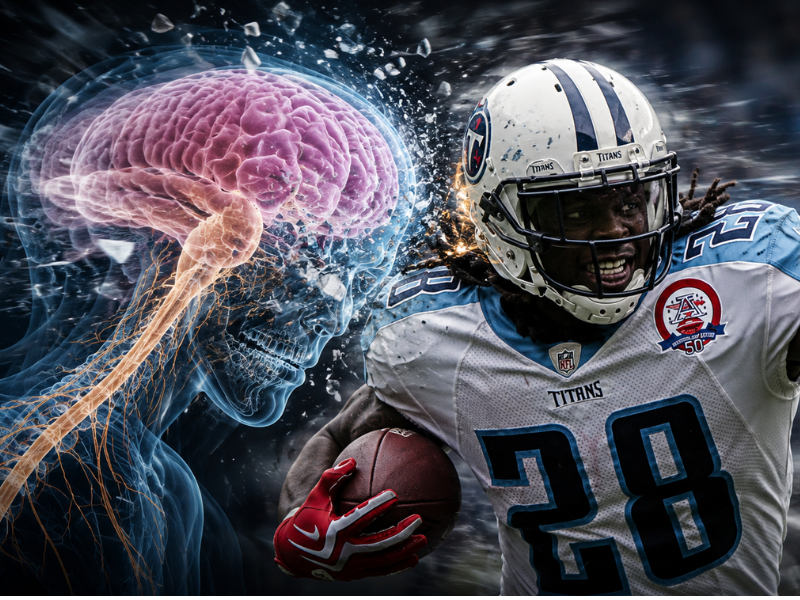
Chris Johnson’s diagnosis is far from an isolated case. It adds to a growing list of former professional football players who have developed severe neurological disorders long after their playing careers ended.
Do you remember the movie Concussion, starring Will Smith?
The film is based on the true story of Dr. Bennet Omalu, the forensic neuropathologist who discovered that several former NFL players had developed a previously unrecognized degenerative brain disease caused by repeated blows to the head.
By examining the brain of Hall of Fame center Mike Webster of the Pittsburgh Steelers, Omalu identified what is now known as Chronic Traumatic Encephalopathy (CTE).
CTE is not the same disease as ALS. They are distinct neurodegenerative disorders with different pathological mechanisms. However, they share certain neurological features, and growing scientific evidence suggests that repetitive head trauma may increase the risk of developing both conditions.
That is precisely why Johnson’s diagnosis has once again intensified the debate surrounding the long-term consequences of professional football.
The Hidden Danger of Repetitive Head Trauma
The scientific community is becoming increasingly concerned not only about major concussions but also about a far more subtle—and potentially more dangerous—threat: subconcussive impacts.
These are the routine blows players sustain during virtually every practice and every game.
Unlike a concussion, they do not cause immediate symptoms such as dizziness, confusion, or loss of consciousness. Players often feel perfectly fine afterward.
Yet the damage may be quietly accumulating.
Over months and years, the brain is repeatedly subjected to rapid acceleration and deceleration inside the skull. Each impact places mechanical stress on delicate nervous tissue, disrupting normal blood flow and triggering persistent inflammation.
Unlike a single traumatic injury, these microscopic insults build up gradually, with the cumulative effect largely depending on how frequently and how long an athlete has been exposed.
One of the most compelling pieces of evidence comes from researchers at Boston University, whose large-scale studies have shown that former NFL players are nearly four times more likely to develop—and die from—ALS than the general population.
While researchers continue to investigate the exact biological mechanisms involved, one hypothesis has gained considerable attention.
Repeated trauma appears to cause chronic inflammation that alters the behavior of a protein called TDP-43.
Under normal conditions, TDP-43 plays a critical role inside the cell nucleus, helping regulate gene expression and RNA processing. However, prolonged mechanical stress may cause the protein to misfold and accumulate outside the nucleus, where it becomes toxic.
These abnormal protein deposits gradually damage and destroy motor neurons—the very cells that are progressively lost in ALS.
But the damage does not end there.
Repetitive head trauma has also been linked to the abnormal accumulation of another protein known as tau within the cerebral cortex.
These tau deposits are considered the hallmark of Chronic Traumatic Encephalopathy (CTE)—the same disease brought to public attention in Concussion.
Although ALS and CTE remain distinct disorders, researchers are increasingly exploring how repetitive brain trauma may contribute to both, raising urgent questions about the long-term neurological consequences of collision sports.
As scientific understanding continues to evolve, one reality has become impossible to ignore: some of the most devastating injuries in contact sports are not the ones players walk away from on game day, but those that emerge silently decades later.
All I know is that the painful reality faced by Chris Johnson, countless other athletes, and their families has once again reignited the debate over player safety and the true price of glory in professional football. I can’t help but wonder whether the consequences of a career on the field—ones that often emerge relentlessly decades after the helmet has been hung up—are truly worth the millions of dollars earned along the way, not only for the athletes themselves but also for the families who ultimately share the burden of the disease.
And while the stories of Eric Dane, Mauricio, Stephen Hawking, and Sergio may have nothing to do with the repeated impacts of a high-risk contact sport, they are equally powerful reminders of a disease that has no cure—a disease that slowly extinguishes the lives of both famous and ordinary people who, until then, had shown no warning signs.
ALS arrives in silence. And it leaves in silence.