



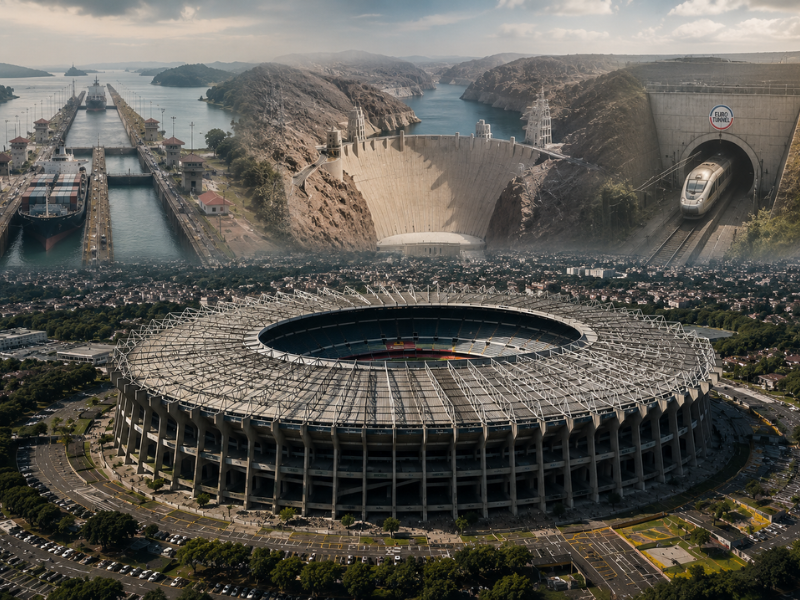
There are giants that leave us speechless, monuments that continue to inspire awe every time we see them—not only because of their sheer size, but also because of the audacity of their engineering, the challenges posed by their terrain, and the visionary thinking that made them possible.
The Panama Canal, widely regarded as one of the greatest engineering achievements in history, was excavated in the heart of a tropical jungle between 1904 and 1914, overcoming immense geological challenges. It transformed global trade forever by allowing ships to be lifted 26 meters above sea level through a system of locks, cross Gatun Lake, and then descend toward the opposite ocean.
Then there is the Hoover Dam, built between 1931 and 1936 on the border between Nevada and Arizona. This colossal structure tamed the Colorado River and required the efforts of more than 21,000 workers. Approximately 3.25 million cubic meters of concrete were used in its construction. Today, cities such as Las Vegas, Los Angeles, and Phoenix depend on it for their water supply.
The Channel Tunnel is another marvel. Stretching 50 kilometers beneath the English Channel, it began construction in 1986 when French and British excavation teams started digging from opposite sides. Eleven giant tunnel-boring machines were deployed to cut through the chalk bedrock beneath the sea.
Fortunately, Mexico has its own engineering giant: the Colossus of Santa Úrsula. More than just a stadium, Estadio Azteca is a masterpiece of Brutalist architecture and seismic engineering, conceived in the 1960s by visionary engineers Pedro Ramírez Vázquez and Rafael Mijares Alcérreca.
The genius behind the Azteca lies in the fact that it was designed from the outset as an artificial crater carved into dense layers of volcanic rock. Engineers excavated downward not only to improve resistance to earthquakes, but also to lower the structure’s center of gravity and reduce its overall height.
Indeed, both the playing field and a large portion of the seating areas are located below ground level. Furthermore, the stadium is divided into four independent structural sections, allowing each block to move separately during seismic activity. This design dissipates energy and significantly reduces the risk of collapse in the event of an earthquake.
Its resilience was proven during the devastating 1985 Mexico City earthquake. The stadium suffered only minor damage and a few cracks. No stands collapsed, and the overall structure remained intact and safe.
The reasons are clear. It was built on stable volcanic rock in the southern part of the city. Much of the seating bowl was constructed downward, using the terrain itself as a natural support system. Its design distributes structural loads differently from a conventional high-rise building, and its exceptionally low center of gravity makes it far less vulnerable to seismic oscillations.
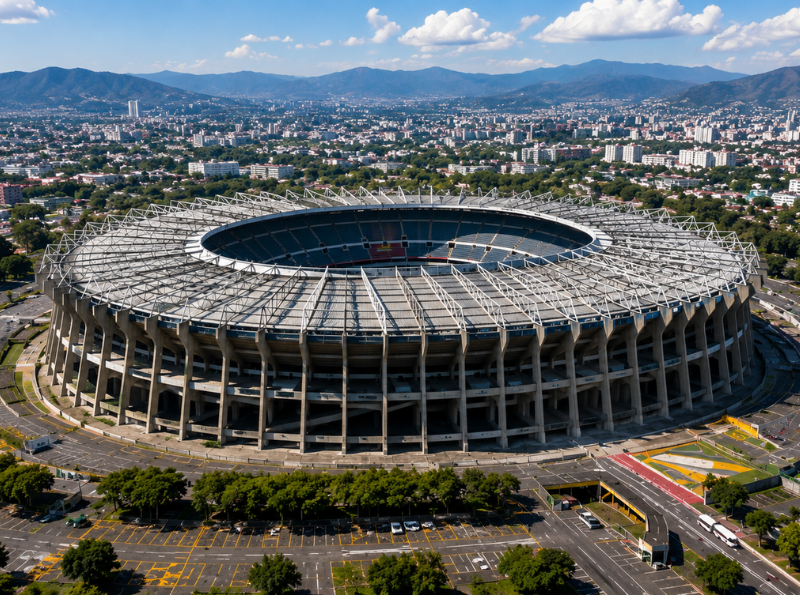
Of course, other iconic sports venues exist around the world, such as Maracanã, San Siro, and Seattle’s Lumen Field. Yet none are quite like the Azteca.
Maracanã may share its monumental scale and bowl-shaped design, but it was built above ground. By contrast, the Azteca required the excavation of volcanic rock to enhance stability and structural performance.
San Siro shares the Brutalist aesthetic and dramatic sense of verticality, but its architects relied on external towers and elevated structural elements. The Azteca, on the other hand, concentrates much of its mass below ground level.
Lumen Field does feature advanced seismic engineering and is designed to amplify crowd noise through acoustics, much like the Azteca. However, what makes the Mexican stadium truly remarkable is that it achieved many of these engineering principles six decades earlier, relying primarily on physics, ingenuity, and structural design rather than the sophisticated technologies available today. Lumen Field, after all, was built in 1997.
I am not sure whether anyone would dare attempt to build a new Azteca today—perhaps one of those billionaire visionaries in the mold of Elon Musk. What I can say is that a stadium of similar characteristics, capable of accommodating 85,000 spectators while meeting modern standards of safety, technology, and sustainability, would likely cost between $1.2 and $2.5 billion.
And that estimate does not even include giant video screens, 5G connectivity, intelligent lighting systems, water treatment facilities, sustainability infrastructure, and state-of-the-art broadcasting centers.
As astonishing as those figures may sound, they are not entirely unrealistic. Wembley Stadium in London, built between 2003 and 2007 with a capacity of 90,000 spectators, required an investment of roughly $1.5 billion. Likewise, MetLife Stadium and AT&T Stadium—both capable of hosting more than 80,000 fans—cost between $2.2 and $2.5 billion.
Among the giants and titans scattered across the globe, I cannot help but remain fascinated by a structure that was, is, and continues to be a pioneer because it dared to think ahead of its time.
And in that regard, Estadio Azteca still plays in a league of its own—one that no other stadium has truly managed to surpass.