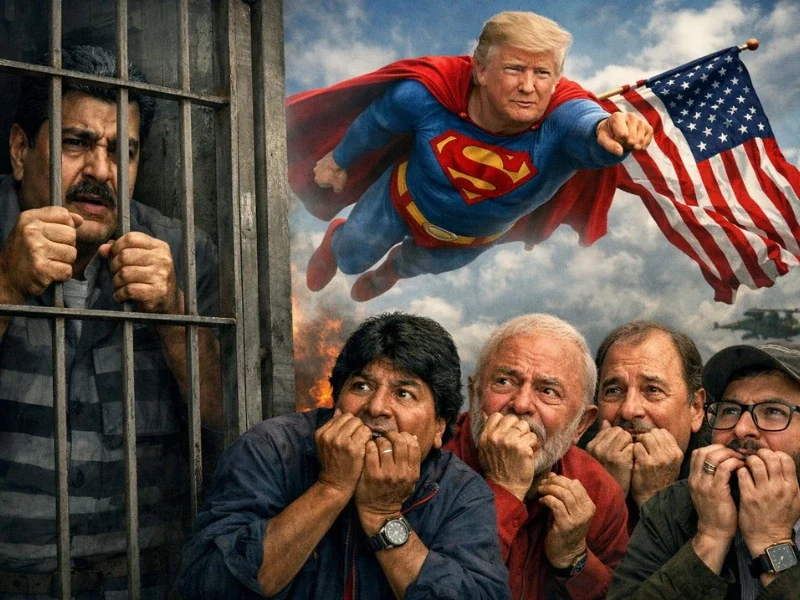
Latin America did not wake up in 2026 with a hangover, but with a tropical blunt blow to the back of the neck. The capture of Nicolás Maduro did more than reconfigure Venezuela’s internal chessboard: it rattled the region’s left, reignited the Washington–Moscow rivalry, and forced governments and left political leaders to look into an uncomfortable mirror—one reflecting power, legitimacy, and the real limits of sovereignty. While some celebrate the end of the Bolivarian model and others cry imperialism, the region is witnessing a hinge moment: not the collapse of the left, but the end of a particular way of exercising it.
Latin America greeted 2026 smelling of gunpowder, geopolitical memes, and reheated coffee in foreign ministries.
Maduro’s capture by the United States is not merely the scandal of the year; it is the kind of event that forces a deeper question: was Bolivarian socialism ever a historical project, or merely a badly produced reality show—finally cancelled due to low ratings and an excess of criminal investigations?
And symbolism matters. Since 1989, when the United States entered Panama to remove Manuel Noriega, the region has not seen a military operation of this scale against a sitting head of state.
Chile in 1973 was different: La Moneda was bombed by Chile’s own armed forces during an internal coup, not by a direct American strike. And yet the historical comparison lingers, like a ghost in the hallway—because Latin America is not accustomed to watching a president extracted as if he were a FedEx package.
One episode, three readings (depending on the channel you tune into)
The regional right—and part of the political centre—are selling it as the end of authoritarian populism: “The party of 21st-century socialism is over; please proceed to the free-market buffet.”
The moderate left is trying to mark distance: “Dialogue yes, bullets no, democracy always… and if you could avoid mentioning us in the communiqué, even better.”
The radical bloc—Cuba, Nicaragua, and aligned sectors—are shouting imperialism at volume eleven, even as their economic credibility hovers at the level of a TikTok finance guru.
And Russia?
Russia appears in parallel: indignant, dramatic, and geopolitically predictable, defending its Caribbean ally as if a bishop had just been knocked off the global chessboard.
Venezuela has long been a key piece in Moscow’s strategy to project influence into Washington’s backyard—from military cooperation to anti-American narratives.
Is socialism or communism collapsing in Latin America?
The short answer is no—but it is changing its skin, like a snake in election season.
The longer answer is more interesting. Classical communism—the manual-based, Soviet, neatly pressed-shirt variety—barely governs anywhere in the region today. It survives ideologically in Cuba and in Nicaragua as a hybrid system: authoritarian, family-run, patrimonial, revolutionary in discourse but clan-based in economics.
What dominates instead is Lula-style social democracy; the Bachelet-era tradition and Boric’s Chile; the national-populism of AMLO in Mexico and Petro in Colombia; pragmatic electoral progressivism in Uruguay; and institutional left-wing governments with open markets in Brazil and Colombia—however reluctantly acknowledged at campaign rallies.
In other words, the left did not die. It simply stopped believing it could run countries as if they were Marx reading circles with unlimited budgets.
The Bolivarian model in crisis—and its three lethal flaws
What is in crisis is the Bolivarian model that sought to build a homogeneous ideological bloc between 2005 and 2025. That experiment revealed three fatal problems:
1. Economics refused to cooperate with the narrative
Countries that took the most radical path ended up trapped in fiscal crises, inflation, capital flight, and extreme dependence on oil or unsustainable state subsidies. When your model requires oil at $200 a barrel to survive, that is not ideology—it is macroeconomic wishful thinking.
2. Institutions eroded
Twenty-first-century socialism did not fail for being socialist, but for being hyper-personalist. Power was not exercised from ministries, but from palaces, clans—and, of course, WhatsApp.
3. Corruption overwhelmed the moral narrative
This is where Maduro and his inner circle became Washington’s perfect example. It was not framed as an attack on the left, but as an attack on a government formally accused of narcotrafficking and narco-terrorism.
You can argue ideology with the United States; when it puts a criminal file on the table, the game moves to a different field.
So, are we witnessing the end of the left? No. What we are seeing is the end of a left that believed it could govern without accountability, institutional balance, or economic credibility.
What comes next for the region is alternation and pragmatism. Political cycles in Latin America usually last between eight and fifteen years. If 2010–2025 marked the rise of the Bolivarian bloc, 2026–2035 will likely be a period of ideological realignment: the right winning in some countries, centrists governing others, and a moderate left remaining strong where economic stability and institutional legitimacy hold.
Maduro’s “friends” are not all the same
This leads to the uncomfortable question floating in the tropical air: will Washington go after Maduro’s “friends”? Lula? Petro? Díaz-Canel? Ortega? Orsi?
Let’s simplify. Lula is an institutional political animal. You may like him or loathe him, but he plays by electoral rules, open markets, and active diplomacy. He may be uncomfortable for Brazil’s right and parts of Washington, but he does not fall into the category of a “security threat” that would justify external military or judicial intervention. Diplomatic pressure, yes. Helicopters over Brasília, no.
Gustavo Petro has had rhetorical clashes with the United States, but he governs within a democratic framework, with an opposition congress, an active press, and competitive elections. His risks are domestic and political—not foreign military capture.
Yamandú Orsi in Uruguay represents the least exciting version of the left for an American hawk: moderate, institutional, almost boring. In a country where alternation is practically a national sport conducted with mate, his risk is the same as any president’s—losing popularity.
Daniel Ortega in Nicaragua is different: authoritarian, sanctioned, and isolated. Even there, Washington has relied on economic and political sanctions, not direct military incursions.
The pattern is clear: the United States acts militarily when it invokes national security—not ideology alone.
Cuba remains a case of historical rivalry, managed through sanctions rather than landings. Any military action there would be seen as a global casus belli, because Cuba is embedded in the geopolitical narratives of China and Russia.
There is no verifiable plan for the United States to replicate similar operations against democratically elected left-wing leaders. There is confrontation with authoritarian regimes accused of security threats—but not with the left by default.
And Diosdado Cabello—does he fall or not?
The man in charge of internal security and party power remains one of the most influential figures within the PSUV. A reward of up to US$25 million for his capture remains active.
There are no public records of properties or bank accounts in Miami or New York under his name. However, multiple investigative reports point to close relatives—such as children—living high-end lifestyles and being the subject of journalistic investigations into foreign investments, not always directly linked to Cabello himself but to extended family networks.
Cabello is not a secondary character. Often described as the “Rasputin of Chavismo,” he has deep networks within the armed forces, the PSUV, and the internal power circuits.
Is he weakened? Yes—because with Maduro off the board, Cabello is exposed. Has he fallen? No. There is no official confirmation of arrest, removal, or loss of institutional power.
Possible scenarios for 2026 include leading internal resistance while maintaining military and party control; negotiating a managed transition within Chavismo as another PSUV figure emerges to manage the vacuum; negotiating discreet exile if judicial or political pressure becomes unbearable; or suffering internal political collapse only if the PSUV and military structures fracture.
He will not fall by international decree or by the capture of an ally. What will fall is the system that sustains him.
And what about the rest of Maduro’s inner circle, riddled with narcotrafficking and corruption?
Investigative journalism has shown how families and networks close to Chavismo have established international financial strategies—offshore accounts, real estate investments, shell companies—to store wealth outside Venezuela, in places such as Miami, Spain, Panama, Portugal, and other jurisdictions.
The U.S. Office of Foreign Assets Control (OFAC) maintains sanction lists against individuals and entities linked to corruption or human rights abuses, freezing assets under U.S. jurisdiction.
Alongside Cabello and Delcy Rodríguez stands Jorge Rodríguez, architect of political control and president of the National Assembly. He has been sanctioned by the United States since 2018 for his role within the regime.
There is no public evidence of personal assets under his name in the United States, but reporting points to elite Chavista environments that have used offshore structures in Miami, Panama, Spain, and elsewhere for decades.
Other figures include Yván Gil, foreign minister and key actor in international negotiations; Tarek William Saab, attorney general since 2017 and chief judicial enforcer against opposition figures; Defence Minister Vladimir Padrino López; and senior military officials such as Elio Estrada. Many are sanctioned, some carry bounties, but none have publicly confirmed personal assets abroad under their own names.
Mexico: the elephant in the room, the cartel in the hallway
As the region shakes, Mexico watches—not from the sidelines, but from a VIP box with premium tequila.
Mexico is not Venezuela. There is no foreign military intervention. But there is an actor that controls territory, capital, and firepower: the cartels.
They are transnational economic organisations that do not fall with electoral alternation, that adapt under pressure, and that possess more resilience than many political parties. Fighting them requires decades of comprehensive policy—not just military force.
Corruption remains another structural issue, deeply embedded across levels of government. Presidents may change; networks survive unless dismantled by strong institutions.
There are no confirmed formal charges against AMLO or his children in Mexico or the United States. What exists is media scrutiny, public allegations, and perceptions of conflict of interest. In politics, perception is not a sentence—but it is electoral ammunition.
How long will the new cycle last?
Classical communism remains marginal in government and is unlikely to expand regionally.
Bolivarian socialism is clearly at its most critical moment after Venezuela and may take years to rearticulate—if it ever does.
Democratic left-wing movements, however, are not collapsing. They are mutating toward pragmatism.
A casual but serious ending
What Latin America is witnessing is not the death of the left, but the exhaustion of an authoritarian model that attempted to govern without checks and balances and ended buried under economic collapse and criminal indictments.
Russia does not defend Maduro for being socialist; it defends him because he was strategically useful. The United States operates under a national-security framework. And the region remains caught between both.
The tropical wall will not collapse overnight. It has been cracking for years. What we see now is the rubble—something no one can credibly pretend is still standing.