





Dear readers,
The wine industry is undergoing a profound structural reset. This is not a temporary downturn or another cyclical slowdown—it is a fundamental transformation.
Three powerful forces are driving this shift: the historic overtaking of wine by spirits, the almost absurd escalation in bottle prices, and a widening generational divide that has led younger consumers to conclude that opening a ready-to-drink cocktail is far more sensible than mortgaging an evening out for a single bottle of wine.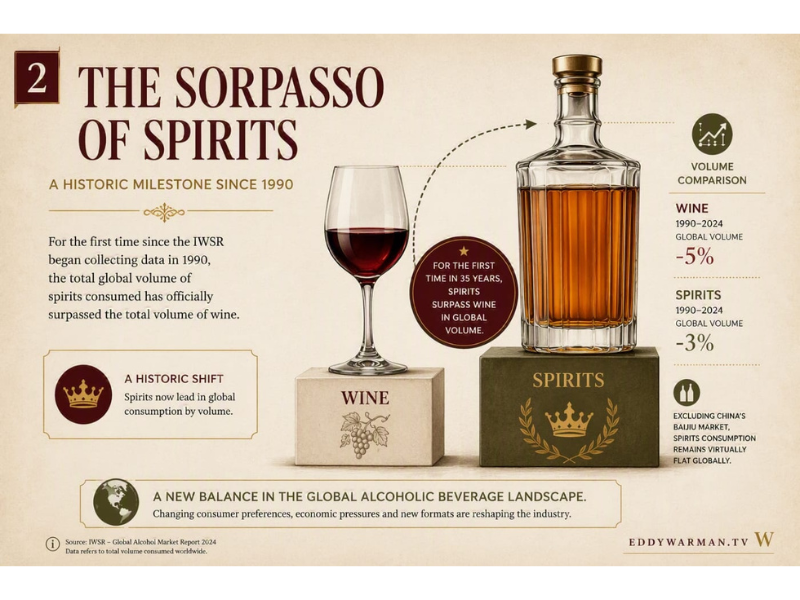
The reality is that this upheaval is being driven by changing consumer behavior, new drinking formats, and evolving purchasing habits. The one thing that has not changed, however, is the astonishing ability of some wine and spirits companies to wonder why sales are declining while pricing every bottle as though it came with its own parcel of vineyard.
Bottle prices have climbed into the stratosphere, becoming an almost insurmountable barrier for a large share of consumers. It is difficult to understand how the industry expects to sell luxury wines to a generation that is struggling to pay rent and quite understandably prioritizes essential expenses over aspirational purchases.
Unless producers reduce prices, reassess their profit margins, and abandon their stubborn commitment to «premiumisation» at virtually any cost, consumption will continue to decline. I was recently walking through El Corte Inglés and was genuinely astonished by how expensive even ordinary bottles had become.
The industry has lost an entire generation of consumers—and spectacularly so. Not because young people have lost interest in wine, its flavours, or its culture, but because the category has become financially disconnected from them. At this point, I doubt that even the most brilliant marketing campaign can rescue an industry that insists on selling exclusivity to a market it has effectively priced out.
During the pandemic, many of us undoubtedly contributed to the boom in wine and spirits consumption. Sales surged, profits soared, and producers enjoyed extraordinary growth while people were confined to their homes. But the world has changed. Back then, consumers were willing to spend more because there was little else competing for their disposable income.
Today’s global economic reality is very different. Unless the industry finds a new formula that reflects the financial reality of Generation Z, ready-to-drink cocktails (RTDs) will continue to eat its lunch.
An Industry at a Historic Turning Point: Spirits Overtake Wine
To understand the scale of what is happening, let me share two reports that recently landed on my desk—and together they confirm that the alcoholic beverage industry has reached a historic inflection point.
The first is the annual report from the International Organisation of Vine and Wine (OIV), while the second comes from the IWSR (International Wine and Spirits Research). Taken together, they paint a sobering picture: wine is steadily losing ground to the resilience of spirits, while the unstoppable rise of ready-to-drink cocktails (RTDs) is reshaping the competitive landscape.
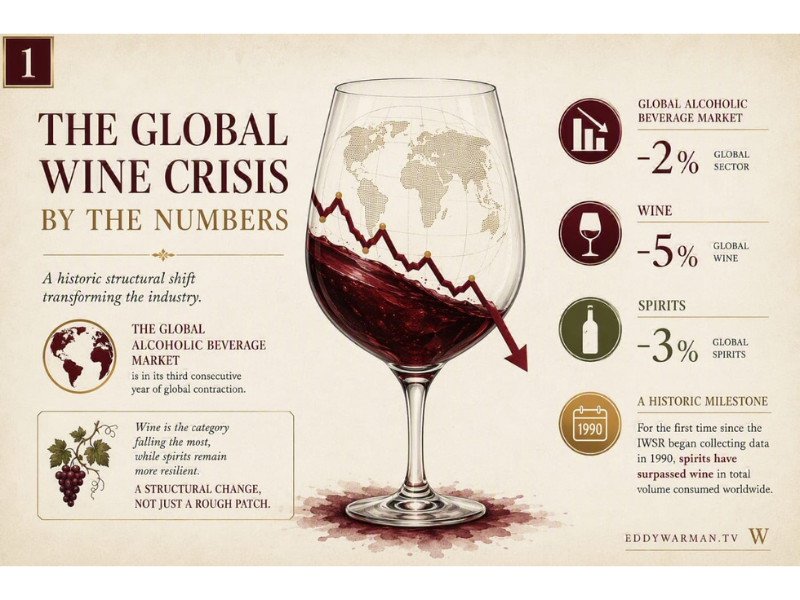
For the first time since the IWSR began tracking global beverage consumption back in 1990, worldwide spirits consumption has officially surpassed wine consumption in total volume.
The broader alcoholic beverage sector has now recorded its third consecutive year of global contraction, shrinking by 2% as inflation and cautious consumer spending continue to weigh on demand. Yet not all categories have suffered equally.
Wine endured the steepest decline, with global volumes plunging by 5%, whereas spirits proved considerably more resilient, slipping by a comparatively modest 3%.
More importantly, once China’s mass-market baijiu—the country’s traditional high-proof spirit distilled primarily from sorghum—is excluded from the equation, global spirits consumption remains virtually flat. Or, to put it less diplomatically, flatter than a pancake. Even then, spirits continue to outperform the wine category by a comfortable margin.
So, What Does the OIV Say About the Wine Industry?
The OIV report makes one thing abundantly clear: the wine industry doesn’t have a cold—it has pneumonia.
It faces the daunting challenge of resizing both its production capacity and its consumer base. And as if collapsing demand were not alarming enough, vineyards themselves are disappearing. Literally.
The Great Vineyard Reduction: Who’s Pulling Out the Vines?
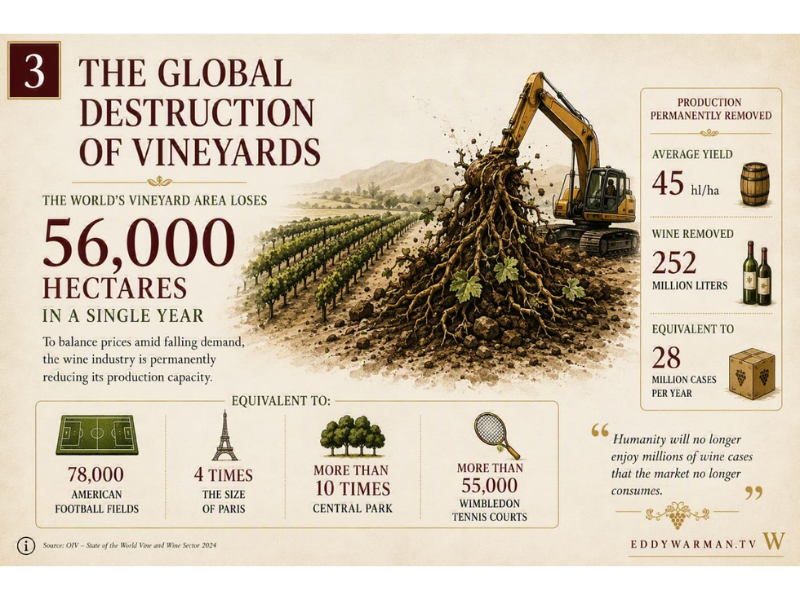
In an effort to stabilise prices amid falling demand, the world’s vineyard area shrank by 56,000 hectares in a single year.
To put that into perspective, that’s roughly 78,000 American football fields, nearly four times the size of Paris, more than ten times the size of Central Park, or over 55,000 Wimbledon tennis courts. The scale is nothing short of staggering.
Assuming an average yield of 45 hectolitres per hectare, this translates into approximately 252 million litres of wine permanently removed from global production—the equivalent of around 28 million cases every year.
For wine lovers, that is an extraordinary loss.
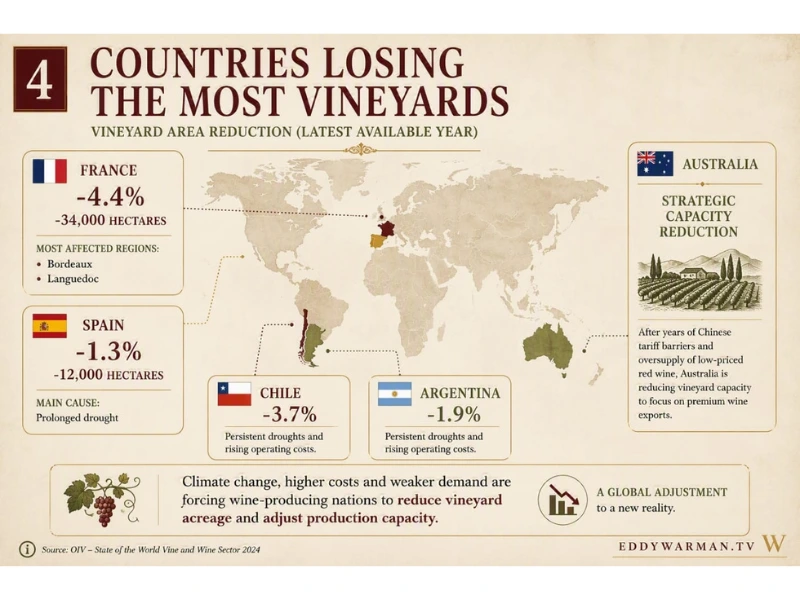
France has borne the heaviest blow—rather like its defeat to Spain on the football pitch—with vineyard area shrinking by 4.4%, representing almost 34,000 hectares. The hardest-hit regions are Bordeaux and Languedoc.
The response has been drastic. Government-funded vine-pull schemes now pay growers to uproot vineyards permanently, reducing cultivated land in an attempt to restore supply-demand balance.
The European Union has also introduced financial incentives based on the number of hectares removed, hoping to curb wine surpluses that consumers simply are no longer buying. The consequence is that humanity will now produce roughly 17 million fewer cases of French wine every year.
Spain follows with a 1.3% decline, equivalent to approximately 12,000 hectares, as prolonged drought continues to suffocate many of its wine-growing regions.
Australia ranks third. After years of Chinese tariffs and chronic overproduction of inexpensive red wine, Australian producers have begun uprooting vineyards across the Southern Hemisphere in order to reduce capacity and refocus almost exclusively on premium exports.
Once again, the industry’s preferred strategy appears to be offering Christie’s-auction prices to consumers whose wallets can barely cover everyday living expenses.
And South America has not escaped the crisis either. Persistent drought and soaring operating costs have driven vineyard losses in both Chile (-3.7%) and Argentina (-1.9%).
Regional Winners and Losers: Italy Returns, South America Splits, and Mexico Defies the Trend
Behind the global production figure of 227 million hectolitres lies a story shaped by climate disruption and the growing impact of global warming. As though declining consumption were not enough, wine producers are now contending with increasingly unpredictable weather patterns. There is, however, one piece of good news: Italy has reclaimed its crown as the world’s leading wine producer.
South America: Sharp Contrasts, Mexico: Remarkable Stability
While South America’s wine landscape reveals striking contrasts, Mexico has quietly emerged as one of the region’s most stable markets.
Brazil has been the year’s biggest surprise. Its production rebounded strongly, while domestic consumption surged 41.9%, reaching 4.4 million hectolitres and cementing the country as one of the world’s most dynamic emerging wine markets.
Argentina, by contrast, experienced a dramatic collapse in domestic consumption, which fell to just 7.7 million hectolitres. Rampant inflation and the erosion of consumers’ purchasing power have pushed wine drinking to historic lows.
Mexico tells a very different story.
Although it remains a relatively small producer on the global stage, its vineyards in Baja California, Coahuila, and Querétaro have largely escaped the large-scale vineyard removals seen elsewhere. At the same time, Mexican consumers are increasingly embracing locally produced artisanal labels and ultra-premium wines, creating a market driven by authenticity, quality, and distinctive regional identity.
Why Have Wine Bottles Become So Expensive?
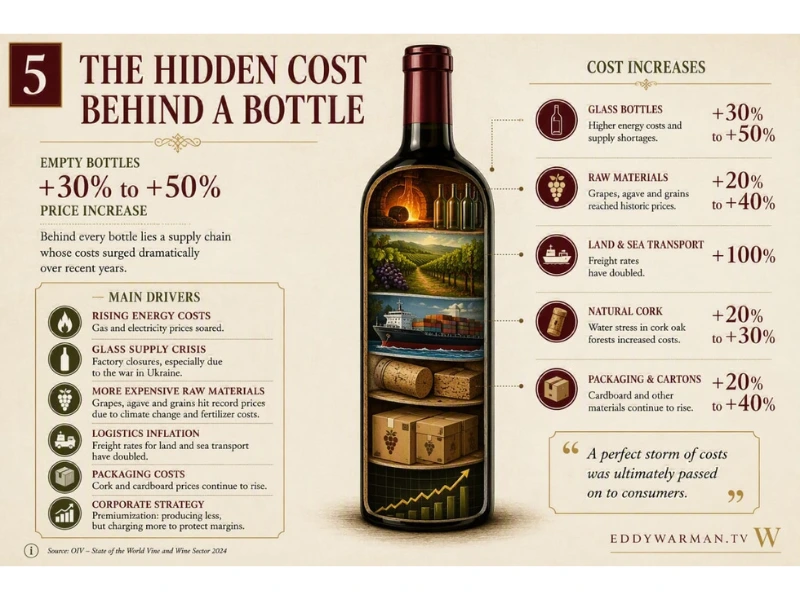
After examining the industry’s global outlook, we arrive at another issue that has only deepened the crisis: the extraordinary rise in bottle prices.
Before pointing fingers at producers, it is worth acknowledging one undeniable fact: production costs have exploded.
The wine and spirits industries have been hit by a perfect storm of rising expenses. The real question is not whether costs increased—they unquestionably did—but rather how much of those increases were genuinely unavoidable, and how much became a convenient opportunity to expand profit margins.
The Glass and Energy Crisis
Manufacturing glass requires melting silica at extremely high temperatures, making the industry heavily dependent on natural gas and electricity. As energy prices soared, the cost of empty bottles rose by 30% to 50%.
The situation was further aggravated by the closure of key glass manufacturing facilities in Ukraine following the outbreak of war, triggering supply shortages across international markets.
Raw Materials Under Pressure
Climate change has also driven grape prices sharply higher as harvests become increasingly vulnerable to drought and extreme weather.
Distilled spirits have faced similar challenges. Blue agave reached record prices, while essential grains such as barley, wheat, and corn—the backbone of whisky and vodka production—became significantly more expensive as drought conditions intensified and fertiliser costs escalated.
Logistics and Packaging
And then came the final blow.
Freight costs for both land and sea transport effectively doubled, while natural cork—already under pressure from severe water stress affecting Portugal’s cork oak forests—continued its relentless climb in price. Cardboard packaging followed the same trajectory, rising almost as steadily as Led Zeppelin’s Stairway to Heaven.
The Corporate Strategy: Premiumisation
Faced with falling consumption, multinational drinks companies such as Diageo and Pernod Ricard adopted a strategy known as premiumisation.
In simple terms, they chose to sell fewer bottles while pushing prices ever higher in order to protect profit margins.
From a financial perspective, the logic was impeccable.
If fewer people can afford to buy your product, simply charge even more for each bottle.
Whether consumers agreed with that logic is another matter entirely.
The Generational Divide: How Tight Budgets Crowned RTDs the New Kings of the Drinks Market
This is where real-world economics collides head-on with the industry’s strategy—as if someone decided to hold a Formula One race in a supermarket car park.
Today’s average young adult simply does not earn enough to buy wine on a regular basis, let alone justify spending even more on a premium spirit such as a Single Malt whisky.
And honestly, who can blame them?
Wages have stagnated, while the cost of living has become increasingly suffocating.
It is therefore hardly surprising that younger consumers suffer from what many now call «checkout anxiety.» Buying a bottle of spirits no longer means purchasing only the alcohol itself—it also means paying for mixers, ice, garnishes, and everything else needed for a single evening out. The upfront cost has become wildly disproportionate.
Even traditional table wines, once considered the affordable gateway into the category, have steadily drifted out of reach as soaring glass prices pushed retail prices ever higher. I can still remember when an inexpensive bottle of wine could rescue a night out on a tight budget. Those days are rapidly disappearing.
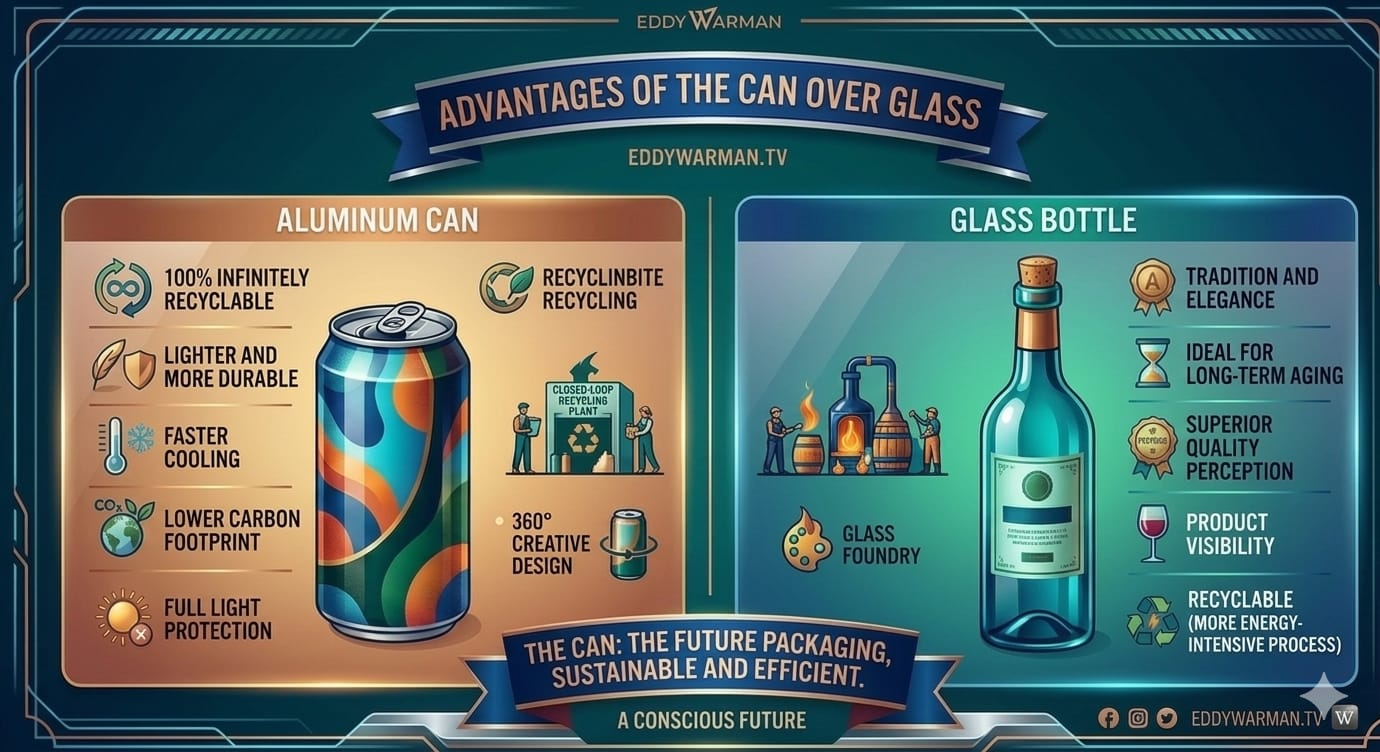
And this is precisely where ready-to-drink cocktails (RTDs) step in—and why they have become such a remarkable commercial success.
RTDs have evolved into one of the fastest-growing categories in the global alcoholic beverage industry, surpassing one billion cases sold worldwide for the first time while posting 3% global growth.
Within the category, premium high-strength RTDs have emerged as the clear standout, expanding by an impressive 15%.
Their success is no accident.
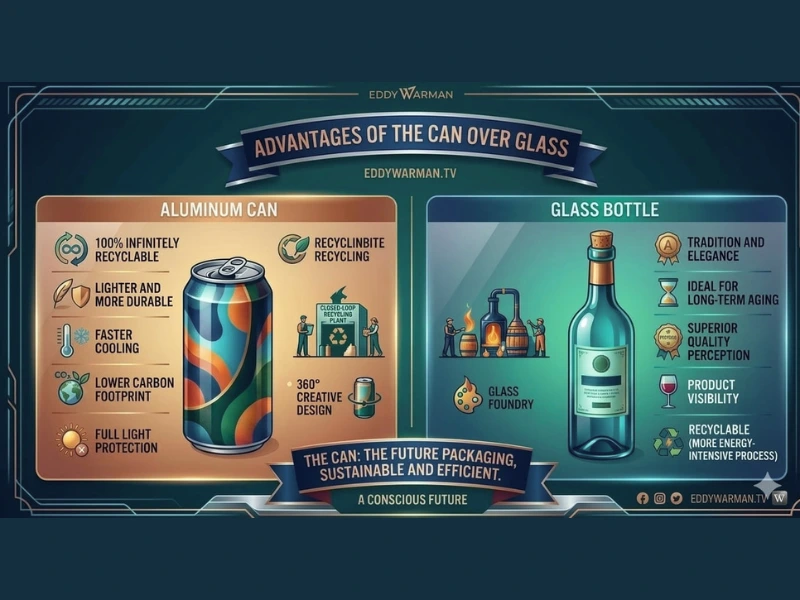
From a manufacturing standpoint, aluminium cans are dramatically cheaper than glass bottles. They weigh less, are virtually unbreakable, and significantly reduce production and transportation costs.
Their compact design also allows substantially more units to fit inside each shipping container, creating major logistical efficiencies throughout the supply chain.
From the consumer’s perspective, the appeal is even more obvious.
RTDs offer convenience, affordability, and certainty.
A young consumer can buy two or three cans, know exactly how much the evening will cost before reaching the checkout, and enjoy an instantly chilled drink without mixers, preparation, or additional expenses.
In other words, RTDs deliver exactly what today’s consumers value most: simplicity, accessibility, and financial predictability.
It is no coincidence that they have become the beverage of choice for an entirely new generation.
A Crisis of Pricing, Not of Passion
After reviewing the evidence presented by both the OIV and the IWSR, one conclusion becomes increasingly difficult to ignore.
The wine industry’s greatest challenge is not that young people have lost interest in wine.
Its greatest challenge is that wine has become financially inaccessible.
Rather than adapting prices and profit expectations to reflect changing economic realities, many producers have chosen to shrink supply instead. Around 56,000 hectares of vineyards have already been uprooted in an effort to manufacture scarcity and support higher prices.
That strategy may protect margins in the short term.
Whether it protects the future of wine is another question entirely.
Because, in the end, I don’t believe young consumers turned their backs on wine.nI believe wine turned its back on young consumers’ wallets.